
|
|
|
 |
When & Where February 7 & 12 at 7.30pm + February 15 at 2pm, 2026 | Queen Elizabeth Theatre Don Alfonso Daniel Okulitch Guglielmo Clarence Frazer Ferrando Owen McCausland Fiordiligi Jamie Groote Dorabella Alex Hetherington Larry, the Bartender Daniel Curalli Trixie, the Pianist Tina Chang Despina Tracy Dahl . The Vancouver Opera Orchestra and the Vancouver Opera Chorus Conductor and Chorus Director Leslie Dala Director Rob Herriot Principal Repetiteur Tina Chang Set design Sheldon Johnson and Costume Design Donnie Tejani Lighting Design Jamie Sweeney Stage Manager Theresa Tsang In Italian with English Projected Titles Reviewer Elizabeth Paterson |
|||||||||||||||||||||||||||||||||||||||
|
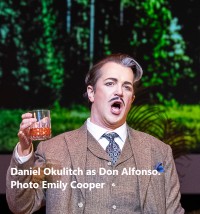
Against a fabulously picturesque backdrop, not of Naples in the 18th century, as in the original setting, but of the Rockies from a grand 1930’s tourist hotel, Vancouver Opera’s Cosi fan Tutte plays out its themes of love and courtship with style. The limpid lakes and post-card mountain views from set designer Sheldon Johnson are as intimately familiar as the parallel changes in the characters. While the young ladies remain visitors from Ferrara, the young men are transformed from Italian officers to Mounties. Despina (Tracy Dahl) is the hotel housekeeper and the manipulative Don Alfonso (Daniel Okulitch) appears as a suave lounge lizard. Jamie Sweeney's lighting kept the action within bounds. The text also bears some adjustments – I’m sure Salmon Arm is not in the original libretto. Even the surtitles support the changes. Barca (boat) is translated as canoe, and couldn’t be otherwise as a quintessential red canoe glides across the stage. DaPonte’s words may be modified but the plot is unchanged. Don Alfonso is eager to persuade his young friends that their fiancées, women they have placed on pedestals, are flesh and blood and as susceptible in love as anyone else. The boys, Gugliemo (Clarence Frazer) and Ferrando (Owen McCausland), are affronted and challenge him to prove it. Following his instructions they tell Fiordiligi and Dorabella that they have been sent on active duty. After grief-stricken farewells the boys leave (by canoe) and the young women are cheered somewhat by two new friends of Don Alfonso’s. These friends are of course the heavily disguised Guglielmo and Ferrando who proceed to woo each other’s fiancée). The “heavy disguise” in Mozart’s day was as ‘Albanians’, a special people to the Viennese, excitingly exotic. In this tongue-in-cheek ‘Canadian’ production ‘log-drivers’ are an apt parallel. The ‘Blue one’ and the ‘Red one’ (this iteration does not dignify the boys with names) actually dance, 'so lightly as to please the girls completely'. Further references to the "Log-Driver’s Waltz" and other cultural shibboleths are gently floated. Like the strong physical comedy which also distinguishes the production, these jokes add froth and delight to enhance the Mozartian lightness without disturbing the plot or the music. Mozart’s music was gloriously unchanged. The orchestra under Leslie Dala was brilliant and lively, with a slyly ingratiating oboe introduction in the Overture. The only concession to modernity was the on-stage ‘hotel lounge’ piano rather than a harpsichord in the orchestra pit. Owen McCausland’s suave and velvety tenor was put to good use in "Un aura amorosa" contrasting nicely with Clarence Frazer’s more aggressive emotions. While the young men flail in a world of deception and heartbreak, the young ladies are more fully realized by Jamie Groot (Fiordiligi) and Dorabella (Alex Hetherington) who match perfectly as sisters on holiday. Hetherington’s "È amore un ladroncello" was light, charming and worldly, a delight. Fiordiligi was given more depth by Jamie Groot’s full-throated, arresting rendition of "Come scoglio" and a touching and lyrical "Per pietà, ben mio perdona". Dapper and a man of the world, Daniel Okulitch was outstanding as the plausible, gleeful Don Alfonso at one point showing an unexpected streak of cruelty. The magnificent Tracy Dahl delighted with an all-round bravura performance. Not only did her splendid vocal chops illuminate Despina’s character and light up the stage, her physical comedy was side-splittingly perfect, but, generously, never upstaged either the other singers or the music and action. A national treasure, her champion in fun and deception was costume designer Donnie Tejani. His dresses were to die for, the log-drivers' disguises a parody in plaid and braces, but the transformation of the vertically challenged Tracy Dahl into both a much taller quack doctor and a much shorter pseudo-notary was the work of a magician. This Mozart offering should please traditionalists and delight newcomers. © 2026 Elizabeth Paterson |
||||||||||||||||||||||||||||||||||||||||||
|
|
||||||||||||||||||||||||||||||||||||||||||
|
|
||||||||||||||||||||||||||||||||||||||||||

 Vancouver
Opera
Vancouver
Opera