4
WHITESPACE
| WHAT'S NEW | |
| books | |
| concerts | |
| dance | |
| exhibits | |
| film | |
| opera | |
| theatre | |
| about us | |
| our reviewers | |
| archives | |
| links | |
| legal stuff | |
| home | |

 |
MOA
I Use My Haida Eyes: The History Robes of Jut-ke-Nay–Hazel
Wilson
When and Where May 14, 2026–October 12, 2026 | Museum of Anthropology, University of British Columbia, 6393 NW Marine Drive
Curator Jordan Wilson
Reviewer Elizabeth Paterson
While she was still very young, Jut-ke-Nay-Hazel Wilson was chosen by her family to become a maker of button blankets, the ceremonial Haida robes which carry the symbols of the clans and are replete with history and meaning. The exhibit opens with two button blankets and a Chilkat blanket made by Jut-ke-Nay-Hazel Wilson, her mother and her daughter, demonstrating the matrilineal heritage of such work.
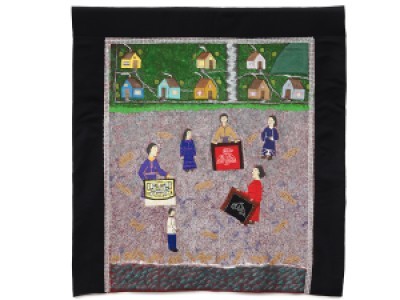
Drawing on the techniques, materials and knowledge she gained over the years, Jut-ke-Nay-Hazel Wilson expanded her practice to include narrative works using mixed media techniques including sewing, applique, embroidery and painting. Leather, wool, cotton, bits of old clothes, a snippet of Hudson’s Bay blanket of exactly the right proportions, shells, beads, and found objects, all highlighted with the sparkles of the Raven clan come together in strong and vivid representations.
All the work in this exhibit is grounded by large black or red rectangles of Melton cloth and framed by mother-of-pearl buttons, as originally used in making button blankets. Colourful cloth is pieced together in collages depicting events, memories and stories drawn from Jut-ke-Nay-Hazel Wilson’s experience.
Jut-ke-Nay-Hazel Wilson is not just a visual artist but also a storyteller. There are very strong narratives in each work and each has a story she wrote for it. Some of these stories, written out in long-hand, are also on display. Others can be heard on the audio sets, read by one of her daughters or accessed with a QR code.
Rather than plan out a work in detail, Jut-ke-Nay-Hazel Wilson preferred to start with a “concept” and a blank cloth and let the work find its own way, perhaps as a sculptor might ‘reveal’ a form latent in the stone, or a novelist’s tale be taken over by the characters. The choice of materials, the meticulous care obvious in the shaping and placing of items, the balance of the design and the vibrancy of the colours all show a fascinating and engaging artistry.
Despite the strong element of story in each robe, there is no chronological or narrative arc in the collection as a whole. Curator Jordan Wilson has instead arranged the works by theme and in so doing underlined the contrasts and similarities amongst the robes.
The first robe in
the exhibition shows Jut-ke-Nay-Hazel Wilson’s mothers and aunties
describing the task she has been chosen for. Within the picture are 2
button blankets and a Chilkat robe, reflecting the exhibitions entrance
display. This robe is titled “Guidance.” Further in are scenes
of a happy childhood, playing, digging for clams and helping with adult
tasks such as stripping spruce roots. Legends, ancestral stories and tales
of the past handed down by previous generations also are displayed close
by. These are as straightforward as to a child’s eye but infused
more subtly with an adult perception of responses and consequences. “The
Mistake” depicts the first contact between Haida and Europeans in
fabulously bright colours showing a teeming azure sea, the Haida in small,
golden watercraft paddling out to greet a ship’s boat with a crew
of three. In the background lies a three-master. At first glance idyllic,
the picture takes on an unsettling mood. The touch of colour in the white,
puffy clouds, the red, white and blue colours of the sailor’s clothing
lend ambiguity to the title. What mistake? Whose mistake? What happened
afterwards? Other pictures are more obviously depictions of the consequences
of colonisation, small-pox and clear-cutting for example. Dialogue though
seems always possible through the stories and the open-ended taletelling.
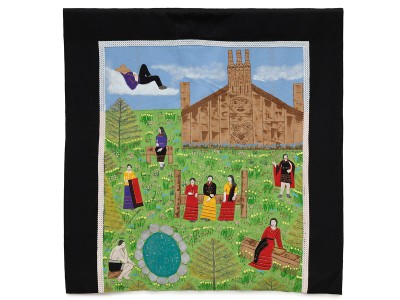
Glory Jut-ke-Nay_Hazel-Wilson
Photo: Fachel Topham
The Haida protected themselves as well as they could, and several robes show them sinking their gold, covering an oil well, or telling magical forest spirits to stay away. The story of an alien visit from space fits into this narrative surprisingly well. Overall, though there are dark and dreadful parts to her stories,Jut-ke-Nay_Hazel-Wilson’s vision is positive, leaving a feeling that we can all survive together.
Photographs do not do the works justice.Go and see them in all their vivid life.
© 2026
Elizabeth Paterson