|
|
|
|
 |
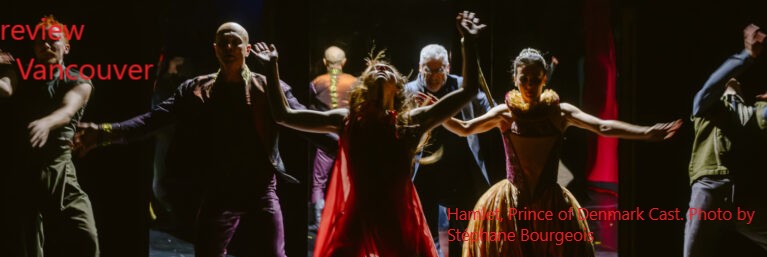
Hamlet, Prince of Denmark When & Where 18 - 21 March, 2026 | Vancouver Playhouse, 600 Hamilton St, Vancouver Choreographer Guillaume Côté Director Robert Lepage Composer John Gzowski Design Robert LePage Costume Design Michael Gianfrancesco, Monika Onoszko Lighting design Simon Rossite Performers Guillaume Côté, Sonia Rodriguez, Robert Golumbek, Carleen Zouboules, Lukas Malkowski, MichelFaigaux, Natasha Poon Wong, Connot Mitton, Willem Sadler Reviewer Elizabeth Paterson |
|||||||||||||||||||||||||||||||||||||||
|
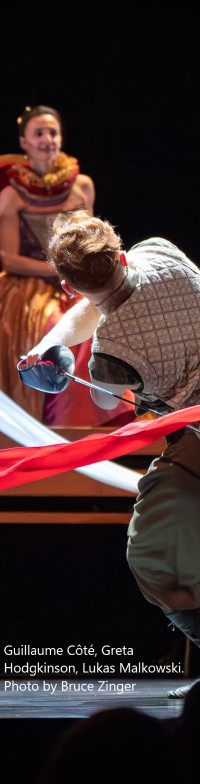
This production is a magnificent achievement. Guillaume Côté and Robert LePage have created an emotionally moving and visually arresting take on Hamlet that brings the play’s discursive and exploratory elements into sharp focus. Together with John Gzowski’s score, Hamlet, Prince of Denmark does what dance and music do best – express emotion and character beyond words. The performance unfolds gradually, opening with a brooding, inky-clad Hamlet (Guillaume Côté) in a direct reference to Shakespeare’s text. Behind him bodies litter the floor, symbols of the play’s themes and this show’s ambitions. The dancers rise to party with the new king (Robert Glumbek) and his queen (Sonia Rodriguez), Ophelia (Carleen Zouboules) a wild party girl. The music hides cannon salutes in its rhythmic drive and fleeting suggestions of a Renaissance sound world while the choreography merges 16th century dance steps into a sharply modern style. This precision and respect for the text runs through the entire production. Occasionally, text enters. Surtitles introduce the characters initially, as– "Enter King", "Enter Queen" - and scene titles are sometimes used to keep the plot clear "Alas, poor Yorick" – or as pointed jokes. The famous quotation “Words, words, words” as Shakespeare’s Hamlet and Polonius fence with each other in a welter of language is reworked into “Sword, sword, sword” and embodied in a sword fight. The exhilarating fight, like everything in this tightly knitted production, works on more than one level and leads to what happens later. LePage’s famous stagecraft is hard at work. Ghosts rise from airy fabric, shadow-puppets fill a screen. In a spare staging, red velour curtains formally divide the stage and change the scene. They also do double duty in combination with Simon Rossiter’s effective lighting to suggest uncertainty, doubts, secrecy and things hidden. When simple objects such as a cup carry weight, there is little need for elaboration. Notably a sheet of blue silk can be the river where Ophelia’s drowning, verbally described by Shakespeare, but here vividly on view. Gorgeous choreography lifts Ophelia high in the water and enfolds her in waves. Beautifully danced by Carleen Zouboules, tragedy was palpable. The casual cruelty inflicted on Ophelia by her father, a graceful, gesturing Michel Faigaux, her swaggering brother Laertes (Lucas Malkowski, wonderfully athletic and modern), and Claudius (Robert Glumbek) is pinpointed by the violence of her pas de deux with Hamlet mirroring the text’s “get thee to a nunnery” scene. Côté hurls Zouboules around in a frenzy of spins and turns. This Hamlet is not mad; he is incandescent with anger and outrage. Guillaume Côté’s Hamlet is tormented and volatile, melancholy in the Elizabethan sense.. Physically strong, he constantly demonstrates determination even as he plays with the idea of suicide. For comic relief we have Rosencranz and Guildenstern. Dressed alike, sharing a choreographic style and musical theme, Connor Mitton (Rosencrantz) and Willem Sadler (Guildenstern) make a charming pair of useful idiots. For empathy and kindness, otherwise lacking in this fierce production, there is the wonderful Natasha Poon Woo as Horatio, Hamlet’s steady friend, doubling as the comical, philosophical Gravedigger. Pulsating and resonant music is inextricably woven into the texture of the dance and fills the space with sound. It can be melodic and plot-defining with themes and rhythms for characters and moods or completely, vibrantly abstract. A flowing, lute-inspired air leaked through a contemporary vibe, a bit of scene-painting vividly depicted the groaning rigging of a ship at sea. With percussive energy and a low instrumental range, the music layers in a unifying sense of foreboding. I feel this is a work in progress. For every breath-taking scene, there are places where magic doesn’t happen, clarity is lost or a resolution fails. LePage is hard to live up to and the choreography is less inventive, though well-integrated overall. I hope there is development to come. © 2026 Elizabeth Paterson |
||||||||||||||||||||||||||||||||||||||||||
|
|
||||||||||||||||||||||||||||||||||||||||||
|
|
||||||||||||||||||||||||||||||||||||||||||
 Dance
House
Dance
House